
Stock markets are in for an event-heavy week ahead with a raft of Q1 earnings from blue-chips, the US Fed interest rate decision and foreign investors trading activity driving investors' sentiment, analysts said. Macroeconomic data announcements, monthly auto sales numbers and global market trends would also guide movement in the domestic equities, they said.

NTPC was the biggest gainer on the Sensex chart, rising 2.44 per cent, followed by JSW Steel, Larsen & Toubro, ICICI Bank, Axis Bank, Nestle, Mahindra & Mahindra and Tata Steel. Bajaj Finance declined over 3 per cent. Hindustan Unilever, Bajaj Finserv, Adani Port and Asian Paints were the other laggards.

Life Insurance Corporation (LIC) , the country's largest domestic institutional investor (DII), has seen a Rs 46,000 crore erosion in the value of its equity holdings amid market downturns in July. The benchmark indices, Nifty 50 and BSE Sensex, have slipped 2.6 per cent from their June 2025-end level to 24,837 and 81,463.09 respectively.


Mutual funds (MFs) are likely to surpass foreign portfolio investors (FPIs) in terms of anchor investments in initial public offerings (IPOs) for the second consecutive year. In calendar year 2023 so far, MFs have invested Rs 5,577 crore as anchor investors, compared to the Rs 5,417 crore invested by FPIs this year. In 2022, MFs put in Rs 9,026 crore as anchor investment, 21 per cent higher than the FPI tally of Rs 7,105 crore. This marked the first time since 2014 that MFs had outpaced FPIs in anchor investments.

From the 30 Sensex pack, Hindustan Unilever fell by nearly 6 per cent after the FMCG major reported a 2.33 per cent decline in consolidated net profit at Rs 2,595 crore for the second quarter ended in September 2024 impacted by moderation in demand from the urban market.

'A balanced portfolio mix of domestic and international equity, fixed income, and precious metals is recommended.'

A sharp fall in the equity market made investors poorer by Rs 5.29 lakh crore on Tuesday when the BSE benchmark Sensex tumbled over 800 points. A host of negative triggers -- muted quarterly earnings, continuous foreign fund outflows and weak trends in Asian and European markets -- dragged the benchmark indices lower. The BSE benchmark gauge tumbled 820.97 points or 1.03 per cent to settle at 78,675.18.

Stock investors will track the ongoing conflict between Iran and Israel, Brent crude oil prices, inflation data and the US Fed interest rate decision for further cues this week, analysts said. Tariff-related news would also dictate trends in the equity market, experts noted.

Investors lost Rs 24.69 lakh crore in market valuation in the last four days of severe drubbing in the equity market. Spike in global crude prices, unabated foreign fund outflows, a strong US jobs data diminishing early rate cut expectations, and the rupee logging its steepest single-day fall in nearly two years dampened investors' sentiment.
Trading sentiment in the stock market this week will be guided by quarterly earning announcements from blue-chips such as Infosys and Bajaj Finance, the outcome of India-US trade talks and global cues, analysts said. Markets may on Monday react to the quarterly results of three heavyweights - Reliance Industries, HDFC Bank and ICICI Bank, an expert said.
Many fund managers at domestic institutions had cut their exposure to Infosys shares ahead of the March quarter earnings.
Among Sensex firms, Bharat Electronics, Eternal, Mahindra & Mahindra, Kotak Mahindra Bank, Tata Motors and Power Grid were the gainers. However, Adani Ports, ITC, UltraTech Cement and Titan were among the laggards.

Domestic institutional investors pumped Rs 2.3 trillion into equities during H1 CY24. Of this, mutual funds contributed 80%.

From the Sensex firms, Axis Bank, Kotak Mahindra Bank, Maruti, UltraTech Cement, Bajaj Finance, ICICI Bank, Reliance Industries, Tata Steel, Bharti Airtel and HDFC Bank were among the major laggards. However, Trent, State Bank of India, Bharat Electronics, Titan and Bajaj Finserv were among the gainers.

Shares reserved for Qualified Institutional Buyers (QIB), including banks and mutual funds in the LIC's public offer were subscribed fully on Monday morning, taking the overall subscription of the issue to a little over 2 times. Against 3,95,31,236 reserved, 4,61,62,185 bids were received, reflecting a subscription of 1.17 times, according to data posted on stock exchanges at 12:12 pm. Non institutional investors' portion was subscribed 1.38 times.
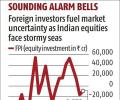
Foreign portfolio investors (FPIs) have withdrawn Rs 25,305 crore from domestic markets since September. FPIs were net sellers in the first two months of 2023, but from March to August, they purchased equities worth Rs 1.7 trillion. This selling trend has caused the National Stock Exchange Nifty Index to decline by 3.2 per cent from its September highs. FPI selling initially began in September as profit-taking but intensified due to rising US bond yields and uncertainty regarding the rate hike trajectory.

Among Sensex firms, Tata Consultancy Services, HCL Technologies, Tech Mahindra, Infosys, Mahindra & Mahindra and Tata Motors were the biggest gainers. UltraTech Cement, JSW Steel, Tata Steel, Adani Ports, Power Grid and Bajaj Finserv were among the laggards.

While gold continues to provide safety after its strong 2025 rally, well-chosen real estate investments held with a long-term view remain attractive.

Investors' wealth plummeted by Rs 5.49 lakh crore on Friday as markets faced a massive correction tracking a weak trend in global peers and fresh foreign fund outflows. Falling for the third day running, the 30-share BSE Sensex tumbled 1,017.23 points or 1.24 per cent to settle at 81,183.93. During the day, it plunged 1,219.23 points or 1.48 per cent to 80,981.93.

Foreign investors have pulled out Rs 26,533 crore from the Indian equity market this month so far owing to increasing allocations to China, concerns over muted corporate earnings and elevated valuation of domestic stocks. While the sell-off continues, the quantum of net outflows has significantly reduced compared to October, when Foreign Portfolio Investors (FPI) withdrew Rs 94,017 crore ($11.2 billion) on a net basis.

State Bank of India, Tech Mahindra, Larsen & Toubro, Tata Steel, Sun Pharma, Infosys, HCL Tech, Axis Bank, Tata Consultancy Services and NTPC were among the biggest laggards among Sensex shares. Nestle, Hindustan Unilever, Titan, Power Grid, UltraTech Cement and ITC were among the gainers.

'As long as Sebi maintains transparency and market stability, the Jane Street episode is unlikely to deter long-term foreign capital.'

Investors should avoid making drastic changes to their asset allocation during a market correction.

From the 30 Sensex firms, Bajaj Finance, Reliance Industries, Tata Steel, JSW Steel, Tech Mahindra, Tata Motors, Kotak Mahindra Bank and Maruti were the biggest laggards. Reliance Industries Ltd, India's most valuable company, on Monday reported a 5 per cent fall in the July-September quarter net profit as weak oil refining and petrochemical business hurt operational performance. ICICI Bank, Bharti Airtel, Asian Paints, Adani Ports, UltraTech Cement and HCL Technologies were among the gainers.

After three post-pandemic years of an upcycle, it was a mixed bag for the realty sector in 2025, with sales volumes in the residential real estate moderating across top cities, and commercial real estate and institutional investments emerging as standout performers. Residential: Volumes soften, value holds firm.

Leading non-banking financial company (NBFC) Shriram Finance on Friday said Japan-based MUFG Bank would invest Rs 39,618 crore, or $4.4 billion, to acquire a 20 per cent stake on a fully diluted basis through a preferential issue of equity shares.

DIIs owned equities worth Rs 73.5 trillion, just 1.9 per cent less than FPIs. This marks a significant change from a decade ago.

In January, SIP account closures surpassed new registrations for the first time.
Among the 30 Sensex firms, Bharti Airtel, Infosys, IndusInd Bank, Sun Pharma, Tech Mahindra, Mahindra & Mahindra, Bajaj Finance and JSW Steel were the biggest gainers. Asian Paints, Maruti, Nestle, Kotak Mahindra Bank, Axis Bank and UltraTech Cement were among the laggards.

From Sensex firms, Tech Mahindra, Mahindra & Mahindra, Tata Motors, UltraTech Cement, Tata Consultancy Services, HCL Technologies, ICICI Bank and Tata Steel were the biggest gainers. Sun Pharma emerged as the only laggard.

From the Sensex firms, Tata Motors, Titan, Eternal, Power Grid, Tata Steel, Larsen & Toubro, Mahindra & Mahindra and Hindustan Unilever were among the biggest laggards. Bajaj Finserv, Asian Paints and Tech Mahindra were the gainers.

Equity benchmark indices Sensex and Nifty tumbled in early trade on Monday amid heightened tensions in the Middle East after the US bombed three major nuclear sites in Iran. The 30-share BSE Sensex tumbled 705.65 points to 81,702.52 in early trade. The 50-share NSE Nifty dropped 182.85 points to 24,929.55.

From the Sensex firms, Eternal climbed 3.32 per cent. Bharti Airtel, IndusInd Bank, Tech Mahindra, Reliance Industries, Tata Motors, HDFC Bank, Tata Steel and Hindustan Unilever were the other major gainers. However, Bajaj Finserv, Axis Bank, Tata Consultancy Services, Titan and Larsen & Toubro were among the laggards.
Domestic institutional investors (DIIs) may not be net buyers of Indian equities in the near term on lack of inflows and are likely to continue with redemption or sit on sidelines, mutual fund officials said.
Benchmark stock indices Sensex and Nifty declined on Monday, extending the losing run to the fourth day amid selling in IT shares and foreign fund outflows. The 30-share BSE Sensex dropped by 247.01 points or 0.30 per cent to settle at 82,253.46. During the day, it fell 490.09 points or 0.59 per cent to 82,010.38 but recovered some of the losses towards the close.

Release of key macroeconomic numbers, monthly derivatives expiry, and global cues are likely to drive stock market movement this week, according to analysts. Markets will also be reacting to remarks made by the US Federal Reserve Chair Jerome Powell, they said. "This week, we expect the market to witness a gradual up-move with stock-specific action.

New investors should not allow themselves to fall prey to FOMO and rush headlong into gold.

Benchmark equity indices Sensex and Nifty pared early gains to settle lower on Wednesday due to late selling in index major Reliance Industries, ITC and HDFC Bank even as the RBI took the first step towards a rate cut in its monetary policy review. Erasing its early gains, the 30-share BSE Sensex fell 167.71 points or 0.21 per cent to close at 81,467.1. During the day, it surged 684.4 points or 0.83 per cent to hit an intra-day high of 82,319.21.

Noting that recent uncertainties created by global tariffs have not impacted the Indian economy severely, Anuradha Thakur, secretary, Department of Economic Affairs, said the central government is hopeful that the recent goods and services tax (GST) rationalisation will ignite the much needed animal spirits in the financial sector.
